A few years ago, sustainability conversations in most organisations followed a familiar pattern. A set of well-designed slides. A few strong statements. And an annual report that spoke about intent more than impact.
That approach no longer works.
Today, when stakeholders look at your business health report, they are not asking what you plan to do. They are asking what changed, by how much, and how consistently. And very quickly, every one of those questions leads to the same place, and that is energy data.
This is why energy monitoring has quietly become one of the most important foundations of credible corporate sustainability.
Let me tell you more about Corporate Sustainability Reporting and how energy monitoring can help.
ESG(Environmental Social Governance) reporting started as a voluntary disclosure exercise. Over time, it has evolved into a decision-making tool for investors, regulators, lenders, customers, and even employees.
An ESG report typically covers:
Many companies now publish ESG data annually alongside their financial reports.
Globally, more than 90% of large enterprises now disclose ESG information, and environmental performance carries significant weight in how organisations are assessed. In energy-intensive sectors, energy and emissions data alone can account for well over half of the environmental score.
What this tells us is simple. “If your energy data is weak, your ESG story struggles to stand up to scrutiny.”
This shift has pushed businesses to move beyond high-level narratives and focus on measurable outcomes, especially when it comes to corporate social responsibility and environmental management.
As ESG reporting matures globally, India has taken a structured and regulator-led approach through BRSR (Business Responsibility and Sustainability Reporting). Introduced by Securities and Exchange Board of India (SEBI), BRSR is now the mandatory ESG reporting framework for the top 1,000 listed companies in the country.
At its core, BRSR is designed to answer a simple but powerful question, and that is “How responsibly does a business operate, not just financially, but environmentally, socially, and ethically?”
Unlike generic ESG disclosures that often vary in structure and depth, BRSR follows a standardised, principle-based format. It requires companies to report measurable data across nine defined principles covering ethics, environmental responsibility, employee well-being, stakeholder engagement, and governance.
This shift is significant. BRSR moves sustainability reporting away from broad narratives and toward verifiable, year-on-year data. Companies are expected to show trends, improvements, and controls, not just intentions.
Every sustainability initiative eventually touches energy in some form.
Energy drives emissions.
Energy shapes operating costs.
Energy influences regulatory exposure and climate risk.
More importantly, energy is one of the few sustainability variables that businesses can measure continuously and improve quickly. Studies consistently show that organisations with active energy monitoring programs achieve 10–30% reductions in energy consumption within two years.
With continuous energy monitoring:
In effect, energy monitoring transforms reporting from a compliance challenge into a structured, repeatable process. It helps businesses stay on the right side of this divide by embedding sustainability into daily operations rather than isolating it in annual reports.
That makes energy not just an environmental concern, but a practical lever for building sustainable business practices that deliver both financial and ESG value.
Under BRSR, environmental disclosures carry substantial weight, and energy-related metrics sit at the centre of these disclosures. Companies must report total energy consumption, energy intensity, renewable energy usage, and reduction initiatives, often across multiple locations and time periods. This is where many organisations struggle.
Manual data collection, estimated figures, and inconsistent reporting formats make it difficult to meet BRSR’s expectations for accuracy and comparability. Despite good intentions, many organisations still rely on fragmented energy data.
Energy monitoring systems address this gap by capturing real-time, location-wise energy data that is traceable and audit-ready.
When reporting season arrives, teams consolidate estimates, fill gaps, and hope the numbers align. This is where inaccuracies creep in, and where ESG credibility takes a hit. Traditional energy audit and management approaches provide useful snapshots, but ESG reporting increasingly demands continuous, defensible data. That is the reason energy monitoring systems are being adopted for corporate sustainability reporting.
An energy monitoring system captures energy consumption automatically, across locations, assets, and processes. Instead of relying on backward-looking estimates, you gain a live view of how energy is actually used across your business.
This changes the nature of sustainability conversations inside the organisation.
Instead of asking, “What did we consume last year?”
You start asking, “Why is this line consuming more today?”, “What changed after the process modification?”, “Where can we intervene before costs and emissions rise?”
That shift from reporting after the fact to managing in real time, is where these reports become credible.
Compliance ultimately stands or falls on the quality of data behind it. While policies, targets, and commitments set direction, it is day-to-day operational data that determines whether sustainability claims hold up under scrutiny.
A look at how energy monitoring strengthens ESG reporting across environmental, social, and governance dimensions, turning sustainability from an annual reporting exercise into a reliable, data-driven business practice.
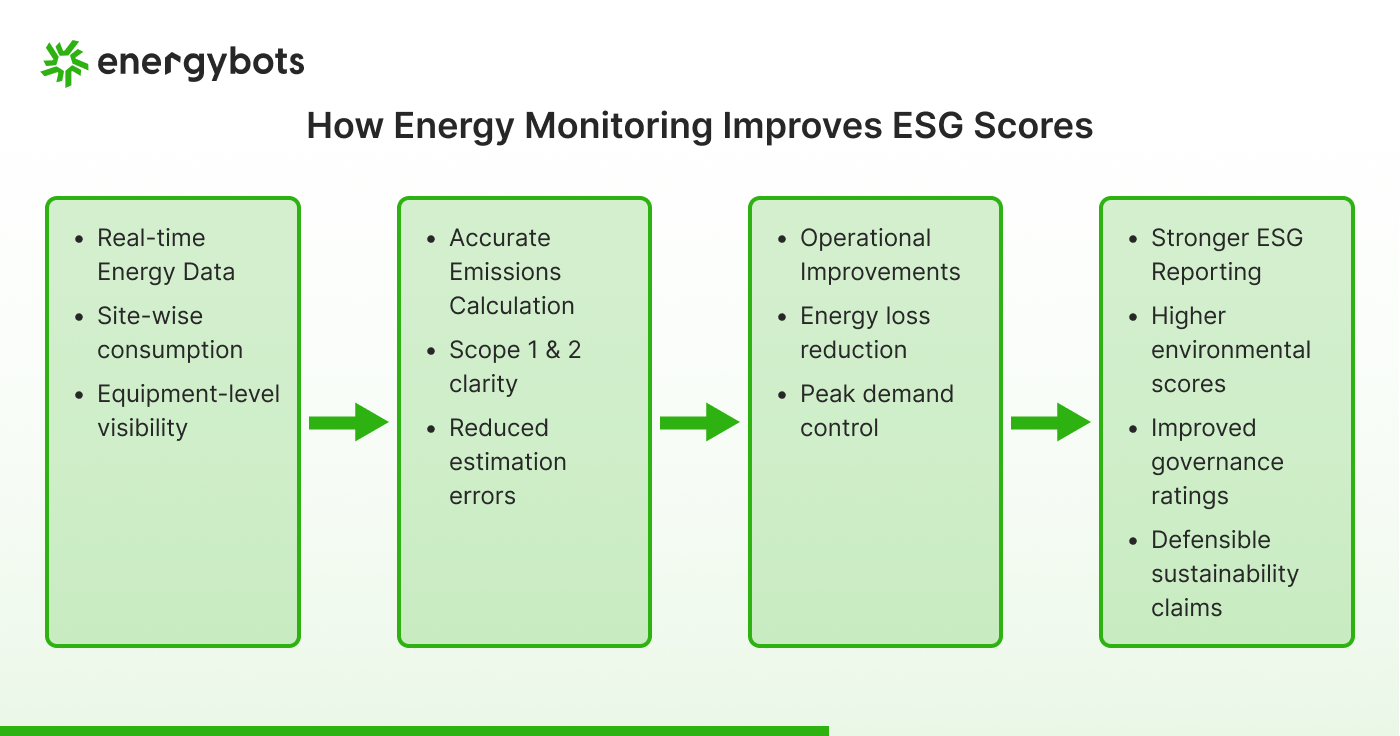
Energy monitoring captures real-time electricity and fuel consumption automatically. Data is time-stamped, traceable, and linked to specific assets or locations, eliminating the inconsistency that often weakens environmental disclosures during ESG audits.
When energy data is continuous, carbon calculations become precise. Year-on-year comparisons carry real meaning, and claims around efforts to reduce carbon footprint are supported by numbers, not assumptions.
ESG assessors value accuracy over intent. Energy monitoring replaces estimated figures and spreadsheets with audit-ready data, making sustainability reporting credible and defensible.
Energy use and emissions form a significant share of environmental ESG ratings, especially in manufacturing, real estate, and infrastructure-heavy sectors. Measured reductions are recognised far more than stated commitments.
Good governance depends on visibility and accountability. Energy monitoring systems create clear data trails, reduce manual intervention, and ensure consistency across sites, proving that compliance is backed by systems, and not ad-hoc data collection.
Accurate, traceable energy data lowers the risk of misreporting, regulatory non-compliance, and credibility loss. This transparency builds long-term trust with investors, regulators, and stakeholders focused on CSR and sustainability.
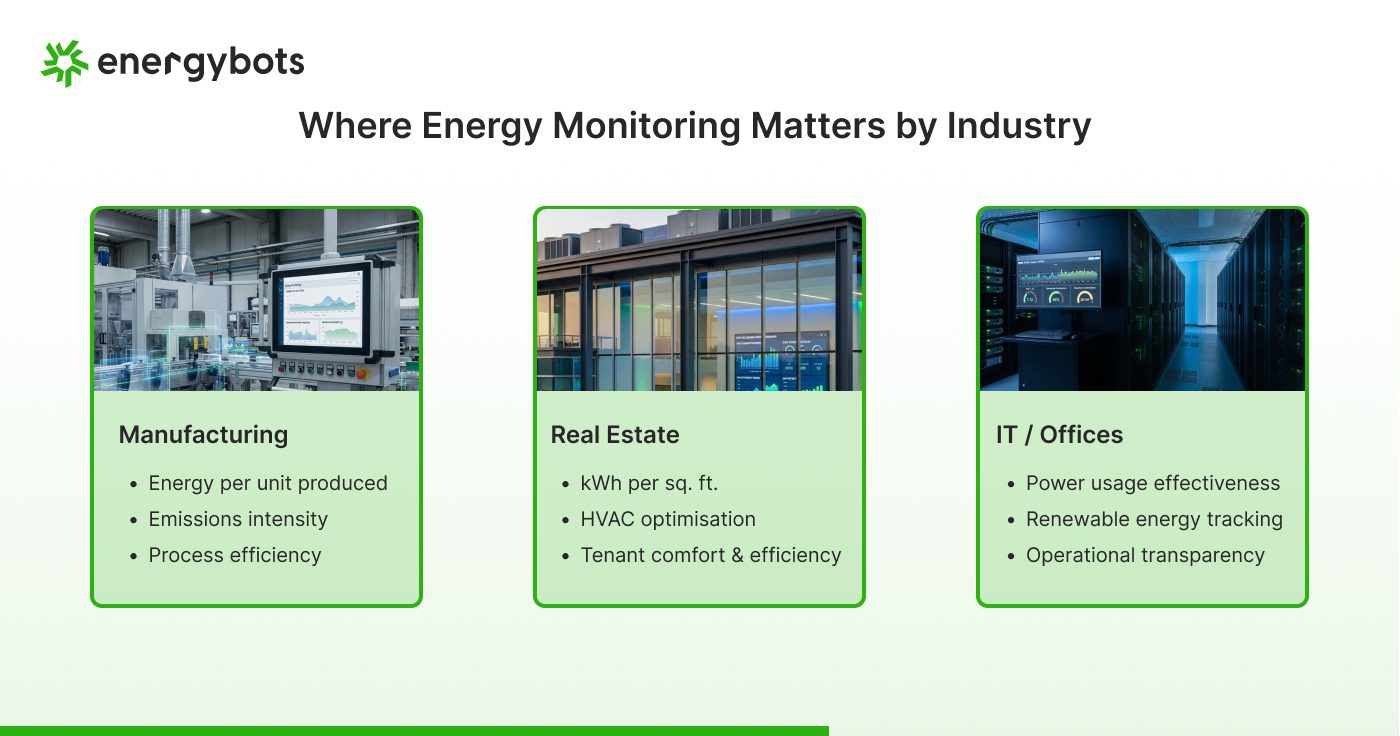
Energy efficiency quietly improves people’s experience. Stable power quality enhances workplace safety, optimised systems reduce equipment stress and downtime, and better environmental control improves comfort in offices and commercial buildings.
Instead of remaining a policy statement, corporate social responsibility and environmental management become operational realities through improved reliability, safer environments, and more efficient infrastructure.
Energy data quickly exposes idle machines, unexplained peak demand spikes, and after-hours consumption that often go unnoticed. Fixing these issues doesn’t require large capital investments—only insight and discipline.
Compliance reporting benefits when energy audits move from annual snapshots to ongoing monitoring. Continuous visibility enables steady improvement rather than reactive corrections.
Centralised energy monitoring ensures uniform ESG data across plants, buildings, and offices, avoiding fragmented reporting and strengthening enterprise-wide sustainability alignment.
Organisations with mature ESG practices treat reporting as a signal to investors and markets, not a regulatory burden. Strong ESG performance improves access to capital, strengthens brand trust, and reduces long-term risk.
Lower energy consumption reduces operating costs while improving ESG scores. This alignment supports sustainable business practices that deliver measurable environmental impact and long-term business value.
If you want your ESG report to reflect real impact, start where impact is easiest to measure and hardest to ignore. Start with energy. Because the most credible sustainability stories are not written in statements. They are written in data.

At Energy Bots, we help organisations turn energy data into actionable intelligence.
Our energy monitoring systems provide real-time visibility across plants, buildings, and assets, enabling accurate energy audit and management and ESG-ready reporting. By digitising energy data at the source, we help businesses improve efficiency, strengthen
ESG disclosures, and support long-term sustainability goals. If your ESG journey needs stronger data foundations, Energy Bots helps you build them clearly, consistently, and with confidence.
Schedule a free consultation with Energy Bots today, to discover your energy saving potential.